Antonio Sanjurjo Badía
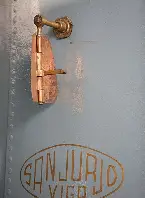
Antonio Sanjurjo Badía was born in Sada, A Coruña, in 1837, into a family of eleven children. From the age of nine, he worked in his father's foundry and clockmaking workshop, and by the age of twelve he was already in charge of the foundry section. He inherited his father's nickname, «El Habilidades», roughly meaning «the man who could fix anything», which would stay with him throughout his life. In 1854, aged just 17, he emigrated to Cuba, where he worked in boiler-making, blacksmithing and foundry work. After saving some money, he returned to Galicia around 1859–1860 and settled in Vigo, the city where he would develop his greatest projects.
In Vigo, he founded La Fundidora, a small workshop that eventually grew into La Industriosa, an important factory located in the area of what is now García Barbón Street. It manufactured steam engines, boilers and ship components. Around 1868, he is credited with building Galicia's first locally manufactured steam engine and boiler. In 1875, he built a boiler for a locomotive, and his company eventually employed more than 200 workers. He also took part in projects such as the La Cristina paper factory, a bus service, Vigo's tramways and a shipyard in Guixar, where fishing and passenger boats were built. He even designed an innovative beehive, inspired by his passion for bees. He was also an employer who cared about his workers: he introduced sickness and retirement benefits and moved payday from Sunday to Saturday so that employees could enjoy their day off. On one occasion, when people tried to persuade him to close his factory, he reportedly replied: «That beautiful town you see from here was built by the workers. This factory, the houses and the streets stretching down to the waterfront belong to me, but all of it exists thanks to the work of hardworking, good men. You may do as you please, but I will not close my factory».
His most famous
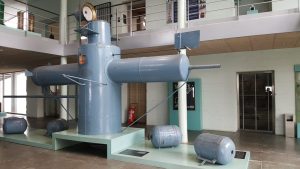 invention emerged during the Spanish-American War of 1898. Fearing an attack on the Galician coast, Sanjurjo decided to use his own money, reportedly around 16,000 pesetas ,to build a submarine torpedo-launching buoy to defend the Vigo estuary. The device measured just over five metres, could carry three people and was powered by a manual pedal system. It incorporated two torpedo tubes and an air mechanism designed to allow it to submerge. On 11 August 1898, it underwent its trials in the Guixar area, with the inventor himself and two workers on board. The dives were successful: some accounts describe periods of up to an hour and a half underwater and depths approaching 20 metres. When he surfaced, Sanjurjo raised a Spanish flag bearing the words «¡POR ESPAÑA!» («FOR SPAIN!»), embroidered by his wife. The submarine never entered combat because the war ended and the threat that had inspired its construction disappeared. Today, it is preserved at the Museo do Mar de Galicia.
Sanjurjo also received official and public recognition: in 1879 he was awarded the Cross of Charles III, and in February 1921 a street in Vigo was named after him, with commemorative plaques designed by sculptor Alejandro Curty. His relationship with his workers was also reflected in accounts of his life: he believed that the success of his factory was built on the hard work of its employees.
Antonio Sanjurjo Badía died in Vigo and was buried at Pereiró Cemetery, where the family mausoleum stands, decorated with a relief depicting the Descent of Christ from the Cross. There is some disagreement over the exact year of his death: certain biographical publications give 1919, while other Vigo-based sources and the Galician General Encyclopaedia place his death in January 1922.
After his passing, the family continued its involvement in business, and his industrial legacy endured for generations. His life tells an extraordinary story: a boy who learned mechanics in his family's workshop, an emigrant who made his fortune in Cuba, an entrepreneur who provided work for hundreds of people, and an inventor who climbed aboard a submarine of his own design in an attempt to protect the Vigo estuary. Vigo preserves his name in a street and his invention in a museum. Perhaps his greatest legacy is the reminder that the city also has a long history of ingenuity, innovation and entrepreneurship.
 -
 -
 -
 -
 -
 -