"We humans can be very unpredictable in conversations, and I try to give that unpredictability a place in my books."
Writer and journalist, winner of the Hercules Poirot Prize 2007 with his book "Revenge of Baudelaire" and finalist of the Silver Skirt award for his book "Fever of the Heart".
Q_When do you leave journalism to devote only to writing?
A- I was thirty-nine when I left classical journalism behind me and became a full-time writer. I say "classical journalism" because, between 1990 and 2003 I was a travel writer in conflict zones, and the pieces I wrote and published about my journeys could be classified between "new journalism" and literature because they were very personal and encapsulated those personal feelings in a broader view of life. But, strictly spoken, from my thirty-ninth birthday until now (almost 66) I have been an author, which, in a small language community like Flanders - Flanders has five million people - isn't that easy. Luckily, I was a prolific author: I published almost 40 books, and some of my work has been translated into English, French, Spanish, Polish, Russian, Portuguese, Swedish, Italian...
Q- In his book «The Revenge of Baudelaire. there is an assassin inspired
by the poet Baudelaire, that is also the name of the book: what is it
that has caught the attention of this magnificent poet who only achieved
recognition once he died as many others too?
A- I'm glad that you're calling Charles Baudelaire a magnificent poet, because, indeed, he was so, and from the first time that I read him in a Dutch translation - I was around eighteen then - I recognized the grandeur of his superior talent. I even saved my pocket money to be able to buy his poem collection "Les Fleurs du Mal" in French. My French wasn't good enough to understand the poet's rich and melodious use of the language of Voltaire, so I read his poems with a dictionary close at hand :-). Baudelaire's spleen made a lasting impression on me. The young buck that I was vowed to write a novel about him, but I had to wait 35 years to be mature enough actually to do it. "Baudelaire's Revenge" was a nice success in Holland and Belgium, France, Suisse, and the US. The novel was also published in Russian.

Q- What places have you lived in that has marked you more or
is it reflected in your books?
A- I liked living in Kaapstad in South-Africa. That city had a special atmosphere, wedged as it is between the sea and the mountains, steeped as it is in a rich and varied cultural past. It was a teeming melting pot of races, beliefs, and social backgrounds, but with the easiness of the African laissez-faire. Sadly enough, the second time I visited Kaapstad, years after my first visit, the atmosphere had become more grim and tense. Some of these observations are visible in my novels, although I've always tried to have a distinct distance between the man Van Laerhoven and the writer Van Laerhoven. In a way, they are two different people.
Q- How would you rate your science fiction or social science books?
A- I'm writing cross-over between literature and the suspense novel. That means that the stories are suspenseful but also that they are multi-layered, and I use a literary style.
Q- Being a lacto-vegetarian and an accomplished rider, are both
inclinations related?
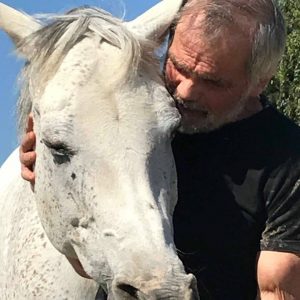
A-That's a difficult question. Maybe the fact that I'm a vegetarian makes me more empathic towards animals, and thus perhaps a better horseman. I respect the horse that carries me, so I'm not its Master, but its partner. We strive to become as one. After each ride, I thank my horse for its willingness to carry me.
Q- What are the best phrases of your characters?
A_The ones that the reader didn't expect. We humans can be very unpredictable in conversations, and I try to give that unpredictability a place in my books.
Q- Do you already know what your next book will be?
A- Yes, it will be "The Shadow Of The Mole," a novel set in WW1 in France, a study of human frailness - and madness - amid the terrible carnage that was WW1.
By Ania Casal. May 2019
 -
- -
- -
- -
- -
- -
-